


Page 8 - Work Force April 2026
P. 8
CSEA members fight
for legislative priorities
ALBANY — Highway workers
dodging speeding traffic. DMV
employees facing harassment
from frustrated customers. Child
protective workers entering homes
without knowing what dangers await.
Those were some of the stories
CSEA members shared with
lawmakers during a recent two-day
lobbying effort at the state Capitol.
CSEA members employed by
state Department of Transportation,
Department of Motor Vehicles,
county departments of social
services and 911 call centers urged
legislators to pass workplace safety
measures and other legislative
priorities this session.
Protecting highway workers
Work zone intrusions, harassment,
injuries and deaths mean highway
workers risk their lives to make
roads safer. CSEA is urging legislation
to increase penalties for speeding
through work zones and violating
the Move Over Law, and expand the
Work Zone Camera Program.
CSEA activists employed at DOT
shared their stories with legislators.
Southern Tier State Employees
Local President Andrew Maroney
said police presence deters speeding
motorists. “Drivers respect the red
and blue,” said Maroney. “They don’t
respect the amber.”
Transportation Region 8 Local
President Darryl Evans-Williams
described hostility from passing
motorists. “[Motorists] throw stuff,
yell and curse,” said Evans-Williams.
Keith Cipperly, a Transportation
Region 1, Rensselaer County
Residency Unit member, was working
the day Robert Bornt died following
a work zone intrusion in Pittstown.
Cipperly also told legislators
about speeding drivers who escape
consequences.
“We had a Tesla zip through on
I-90 at 112 mph,” said Cipperly. “The
cops said they were moving too fast
to catch them.”
Reducing harassment
State Department of Motor
Vehicles (New York City) Local
President Benjamin Greene, State
Department of Motor Vehicles
(Region 2) Local member Michael
Ko, Dutchess County Unit Secretary
and DMV worker Steve Rifenburg,
and Motor Vehicle (Albany) Local
President and CSEA Statewide
Legislative and Political Action
Committee Chair Cindy Stiles
discussed with lawmakers the need
for legislation that would increase
penalties for assaulting or harassing
DMV workers while on the job.
Each described verbal and
physical harassment from
customers, noting frustration often
stems from long wait times caused
by understaffing. Meanwhile,
continued harassment drives staff
away, worsening understaffing.
Urging for panic buttons
Department of Social Services
(DSS) workers urged lawmakers to
pass legislation that would create
additional safety protections such as
panic buttons
Nassau County Local 2nd Vice
President Donna Worsley-Hines,
Erie County Social Services Section
President Renee O’Neill, Saratoga
County Unit Vice President Ron
Woodbeck, Cortland County Unit
President Melissa Norton, and
Orange County Unit Secretary
Shanea Butts, all of whom work in
Child Protective Services (CPS) in
their respective counties, shared
situations where a panic button
could have immediately alerted
emergency services.
Woodbeck said CPS workers often
enter homes with only a name badge
and little information about what
they may face.
“We have families we want to go
home to,” said Woodbeck. “These
panic buttons would give us the
extra layer of security and safety.”
O’Neill shared a co-worker’s
harrowing experience during a
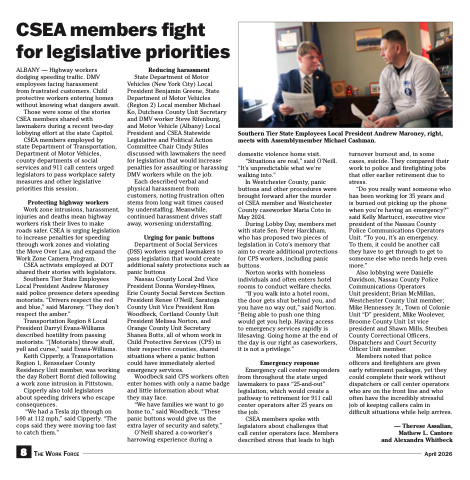
8 The Work Force Southern Tier State Employees Local President Andrew Maroney, right,
meets with Assemblymember Michael Cashman.
domestic violence home visit.
“Situations are real,” said O’Neill.
“It’s unpredictable what we’re
walking into.”
In Westchester County, panic
buttons and other procedures were
brought forward after the murder
of CSEA member and Westchester
County caseworker Maria Coto in
May 2024.
During Lobby Day, members met
with state Sen. Peter Harckham,
who has proposed two pieces of
legislation in Coto’s memory that
aim to create additional protections
for CPS workers, including panic
buttons.
Norton works with homeless
individuals and often enters hotel
rooms to conduct welfare checks.
“If you walk into a hotel room,
the door gets shut behind you, and
you have no way out,” said Norton.
“Being able to push one thing
would get you help. Having access
to emergency services rapidly is
lifesaving. Going home at the end of
the day is our right as caseworkers,
it is not a privilege.”
Emergency response
Emergency call center responders
from throughout the state urged
lawmakers to pass “25-and-out”
legislation, which would create a
pathway to retirement for 911 call
center operators after 25 years on
the job.
CSEA members spoke with
legislators about challenges that
call center operators face. Members
described stress that leads to high
turnover burnout and, in some
cases, suicide. They compared their
work to police and firefighting jobs
that offer earlier retirement due to
stress.
“Do you really want someone who
has been working for 35 years and
is burned out picking up the phone
when you’re having an emergency?”
said Kelly Martucci, executive vice
president of the Nassau County
Police Communications Operators
Unit. “To you, it’s an emergency.
To them, it could be another call
they have to get through to get to
someone else who needs help even
more.”
Also lobbying were Danielle
Davidson, Nassau County Police
Communications Operators
Unit president; Brian McMillan,
Westchester County Unit member;
Mike Hennessey Jr., Town of Colonie
Unit “D” president, Mike Woolever,
Broome County Unit 1st vice
president and Shawn Mills, Steuben
County Correctional Officers,
Dispatchers and Court Security
Officer Unit member.
Members noted that police
officers and firefighters are given
early retirement packages, yet they
could complete their work without
dispatchers or call center operators
who are on the front line and who
often have the incredibly stressful
job of keeping callers calm in
difficult situations while help arrives.
— Therese Assalian,
Mathew L. Cantore
and Alexandra Whitbeck
April 2026

