During our union’s statewide and region women’s conferences, the iconic Rosie the Riveter often makes an appearance, including through costumes or collateral.
Rosie the Riveter represents the millions of women who worked in factories and shipyards during World War II. She became associated not only with a historic moment, but with expanded opportunities for women in the workforce. More than 80 years later, Rosie remains an icon of women’s empowerment.
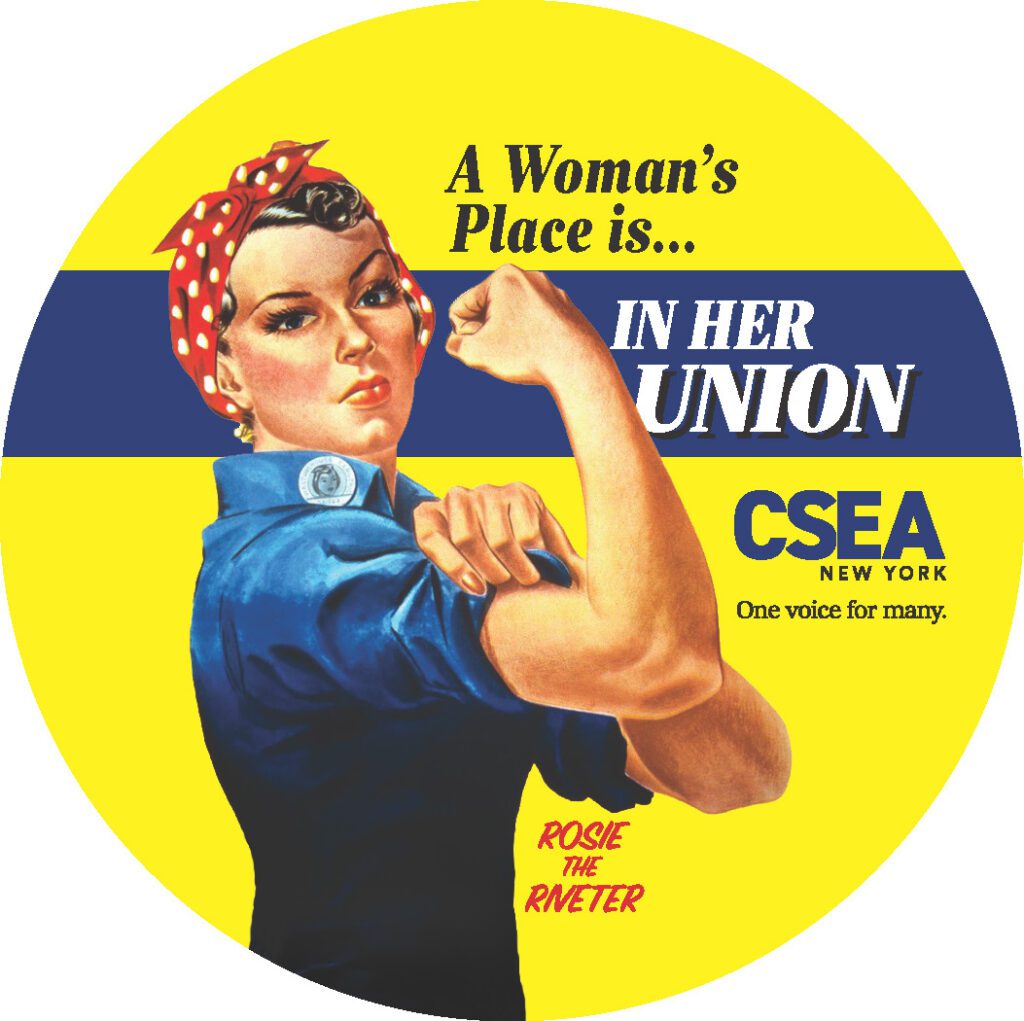
But who was Rosie the Riveter?
During World War I, millions of men left their jobs to fight overseas. To maintain production on vehicles, munitions and other goods, women were encouraged to fill industrial jobs traditionally performed by men.
When the U.S. entered World War II, millions of women once again stepped into industrial jobs to replace men who joined the military. To maintain war-related production, the federal government launched marketing efforts, such as posters and commercial advertising, to encourage women to work at these jobs.
The term “Rosie the Riveter” was coined in 1942 in a song written by Redd Evans and John Jacob Loeb, which portrayed Rosie as a hardworking factory worker helping the war effort.
Rosie’s true identity, however, remains debated. She is believed to be a combination of several women factory workers and was commonly depicted wearing a blue factory uniform, a red polka-dot bandanna covering her hair and flexing her arm with steely determination. In 1942, artist J. Howard Miller created the famous “We Can Do It” poster for Westinghouse to motivate its workers. At the time, the image was not associated with Rosie the Riveter. When it was rediscovered in the early 1980s, it became associated with the character and with working women.
Impact on workers
Rosie’s impact extends far beyond wartime propaganda. Women filling industrial jobs laid many of the foundations of advancements for working women.
Millions proved they could perform jobs long considered “men’s work” and wanted to continue to work outside the home. The wartime economy also allowed women to sustain a living to support their families. The war also allowed more employment opportunities for Black, Hispanic and Asian women.
The war also temporarily advanced universal child care. In 1940, legislation established a nearly universal federal child care system. While successful, the program ended shortly after the war.
After the war ended, many women were laid off and replaced by men returning from the war, with the expectation that women would resume more traditional roles working inside and outside the home.
Still, women increasingly sought paid work in less traditional roles. CSEA women, along with women across the labor movement have fought for expanded opportunities—and continue that fight.
Rosie the Riveter remains a lasting symbol of that inspiration and determination.