
The Trump administration’s mass deportation agenda is wreaking havoc on families, communities and the economy.
The United States is approaching zero labor-force-growth due to an aging population and falling fertility. Immigration is the anecdote to demographic disaster.
Immigrants are vital members of our workforce and unions. This anti-worker agenda is crippling industries that rely heavily on immigrant labor. Many of the 675,000 immigrants deported last year worked in manufacturing, construction, hospitality and agriculture.
The Brookings Institute estimates between $40 and $60 billion in consumer spending was lost to deportations in 2025.
A shrinking workforce lessens the economic support that immigrants provide to federal, state and local budgets through taxes paid. A 2024 American Immigration Council Report estimates that undocumented immigrant households paid more than $70 billion in federal, state and local taxes in 2022.
While immigrants are portrayed as a drain on resources, they contribute substantially to the social safety net. In 2016, immigrants paid $22.6 billion to Social Security and $5.7 billion to Medicare, benefits many immigrant workers are unable to access but help keep afloat.
The administration claims the agenda is to deport criminals, but the Cato Institute obtained internal Homeland Security data showing that 73% of those detained by ICE between October 1 and November 15 had no criminal convictions.
Yet the path to citizenship is a long and expensive bureaucratic maze that is not always clear or fair.
Below is one CSEA member’s story.
A worker’s story

LAKE PLACID — For asylum seekers like CSEA Olympic Regional Development Authority (ORDA) Local member Alejandro Bravo, the decision to stay in one’s home country or leave often comes down to a choice between life and death.
“I grew up with so many problems,” said Bravo, who is from Venezuela. “We faced many indignities. We learned how to laugh at disgrace.”
Violence, failed economic policies and chronic food shortages fueled massive protests in Venezuela in 2014. Bravo joined the movement. A government crackdown against protesters—some of whom were beaten, imprisoned or killed—only fanned the flames of civil unrest.
“I had to do something to push back against power doing too much damage to a beautiful country and beautiful people,” said Bravo, who continued protesting until his life was at risk.
With a tourist visa, Bravo left his home and family, arriving in Florida in December 2018.
Asylum seekers must apply for asylum within one year of arrival in the United States.
Bravo applied within two months.
The next step—obtaining a work permit and Social Security number—was estimated to take three months. Bravo waited 18.
Bravo submitted his biometrics—fingerprints, photo and signature—to U.S. Citizenship and Immigration Services (USCIS), a standard part of the immigration process that confirms identity and checks immigration and criminal history.
Bravo was told the final step—an interview to determine whether his asylum case would be approved or denied—would happen in six months. Seven years later, he is still waiting.
Sunny days
“As a child, I dreamed of being in a place with four seasons,” said Bravo.
Working in a hotel as a night auditor in Orlando, Bravo liked the work, but the lifestyle didn’t suit him. When the opportunity arose for a job in New York, Bravo jumped at it.
Bravo grew up in an industrial town with an electrician father who worked at a mill. Bravo’s schooling included electrical training and construction. He attended college and also taught English. Highly transferable skill, a strong work ethic and an easygoing nature led to success in every job he held.
“A manager at the staffing company I worked for said they had a position for me at a resort in Lake Placid,” said Bravo.
When Bravo arrived in Lake Placid in October 2019, fall was fading fast. He soon bought his first winter coat.
He was beginning to feel more at peace and settle into his new life.
“I just fell in love with this place,” said Bravo. “I learned to appreciate the sunny days when they were here. The weather and the changing seasons made me appreciate life more.”
Bravo also fell in love. Lake Placid is where he met his wife, Mina.
One night, while out with friends, he met someone who worked at ORDA, who suggested Bravo apply for a job. Bravo already had two jobs, so when he was hired, he left one and moved to part time at the other. He saw more opportunity in a maintenance position that paid fairly, included good benefits such as paid time off for sick days and vacations, and had union representation.
Winter
As 2025 began, so did an aggressive rollout of a mass deportation agenda by the second Trump administration. With quotas and incentives for U.S. Immigration and Customs Enforcement (ICE) officers, workers were being plucked off job sites, sent to detention facilities in faraway states, deported to the dangerous countries they fled, or transferred to countries they had no connection to.
Because they were married, Bravo and his wife had their cases linked in the USCIS system and kept a letter from their attorney in their car in case they were stopped.
Mina was picked up in early November on her way to work.
“I started to panic,” recalled Bravo. “I ran to [CSEA ORDA Local President] Don Walton. I said she had everything. We had everything but it didn’t matter.”
“It was not happening to me—it was happening to someone I care about. It was terrifying,” said Bravo. “That was the most stressful month of my life.”
Mina was first sent to a jail in Clinton County and housed with the general population before being transferred to another jail in Lockport, six hours from Lake Placid.
December 8
After 38 days, legal wrangling and bond posted, Bravo drove to Lockport for the second time in three days, anticipating a reunion.
“I was very excited that night after so many ups and downs,” said Bravo. “I was in a waiting room and was assuming it was part of the protocol. I was being naive.”
“Three ICE agents came toward me. I said, ‘You’re here to release my princess.’ I went to shake their hands,” said Bravo. “They asked for my ID. She walked in through the door. They start asking questions, and I was hugging Mina. They started asking about my status and that’s when I knew.”
Bravo noted that the agents told him that if he was detained, it would speed his own immigration process.
“I don’t really process emotions too fast, not sure if that is a blessing or a curse,” said Bravo. “They put me in handcuffs. I begged them to give me one minute to explain logistics to my wife—where the keys are, the hotel, everything.”
Bravo arrived at a chaotic scene at the processing center near Batavia around 8 p.m.
“A lot of the people who were with me had work clothes or uniforms on,” said Bravo. “We were all first put into a big cell while waiting for processing, given a wristband and blue clothing.”
Blue, the color code for noncriminal detainees, was the only color Bravo saw.
“Three days in a process cell with 20 or more people sleeping on a floor, waiting for room to free up in the detention center. Some people had been there for 10 days,” said Bravo.
Bravo struggled with feelings of anger and hatred, emotions that he noted are not part of his nature.
“It’s pretty hard to break my will,” said Bravo. “I was so pissed. I didn’t do anything wrong to deserve this—not just for me, but to my wife, too.”
“It was back to back and hit me right in the jaw,” said Bravo. “There were some moments when I was so down and thought about going home to not live in a place where I feel like I don’t belong.”
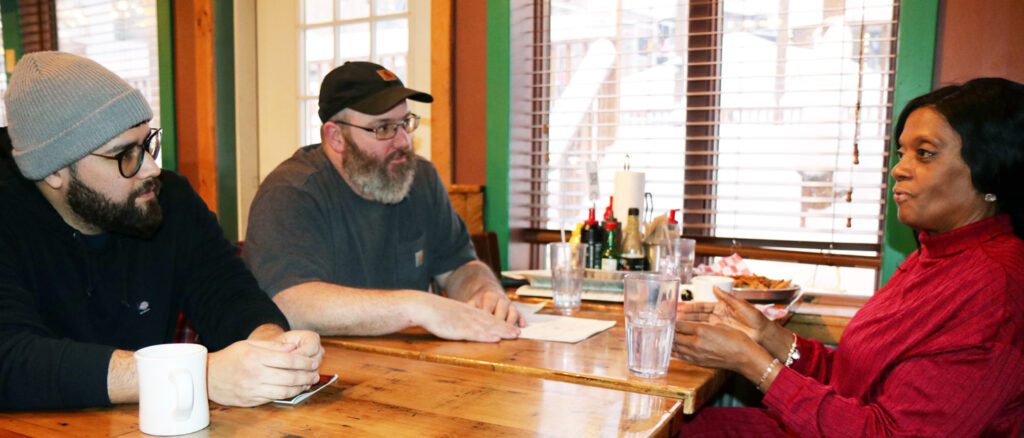
Union family
As Bravo’s nightmare continued, Walton reached out to CSEA.
“Who else am I going to call?” said Walton. “Less than six months in as local president, I called my labor relations specialist Emy Pombrio, about leave donation. She told me this event was beyond his control, so that set in motion the leave donation.”
Capital Region President Shana Davis connected with Walton the same day.
“I started asking questions. I wanted him to be able to know that every member matters and every local should be supported,” said Davis. “At the time, I didn’t know what we could do, but wanted to do everything we could. The level of fear, intimidation and violence where he came from—only to have those same feelings here—is something that stays with me.”
Walton also felt the injustice.
“You can have whatever feelings you have about illegal immigration,” said Walton. “But how you can take someone who came here legally was following the process and treat them this way? I didn’t realize we were in Nazi Germany. Unless you are Native American, we are all immigrants.”
Davis and Walton stayed in close contact and helped coordinate monetary donations to offset legal costs. Walton kept Davis and Pombrio updated and stayed in touch with Bravo during his detention.
“I would wait to hear from him—for his call,” said Walton.
During his detention, Bravo became aware of our union’s efforts to help.
“My wife said, ‘Donny is helping,’ and she told me there was a lot of people pulling for me,” said Bravo. “My wife is my only family here. This place became my family. The presence of our union makes me happy and makes me feel like I am not alone.”
The leave donations from ORDA co-workers allowed Bravo to keep his paycheck coming and continue accruing time on the books with no break in service.
After release on bond and return to work in mid-January, Bravo asked Walton if he could address his co-workers at their weekly operations meeting.
“I felt the need to extend my gratitude,” said Bravo, “It was pretty emotional.”
“He lightens up every room he walks into,” Walton said. “People at work say he brings the light—but Alejandro is the light.”
Despite this, Bravo is still struggling.
“It’s hard to now feel safe in a place where I came to seek peace. I don’t feel free anymore,” said Bravo. “After everything I have been through—trying to fight criminals in Venezuela—now I feel like people look at me as a criminal. I even have to wear an ankle monitor like a criminal.”
Even with spring and sunny days eventually coming, Bravo and his wife are not going out as much. He continues his check-ins, goes to work, comes home—and waits.
— Therese Assalian