SEAFORD — After years of the Seaford Library Board of Trustees using the tax cap as a reason to deny workers fair pay, Seaford librarians decided it was time to stop talking about organizing and start taking action.
Now, they are some of CSEA’s newest members.
The group previously sought raises but were mostly rebuffed by the library board.
“Back in 2020, we were promised good raises because we learned additional skills to work remotely during COVID lockdown,” said Seaford Librarian Jillian Pelliccia. “That year, we got one of our worst raises. It felt like a slap in the face.”
In 2024, the group read statements expressing their desire for a raise at a library board meeting.
“We were successful in getting a higher raise percentage, but right after that we were told, ‘that’s as good as you’re going to get. It’s going back to 2%,’” said Pelliccia.
Poor pay forced some librarians to get second jobs, so the workers decided to explore forming a union.
When the organizing process began, the workers were unfamiliar with unions, so they connected with other library workers in the area to ask questions.
CSEA Wantagh Library Unit members suggested Seaford librarians contact our union.
After the initial outreach, CSEA Statewide Organizer Ursula Howard and CSEA Deputy Director of Organizing and Private Sector Jessica Riley met with the group to explain the process of organizing. Howard continued to work with the group through their organizing efforts.
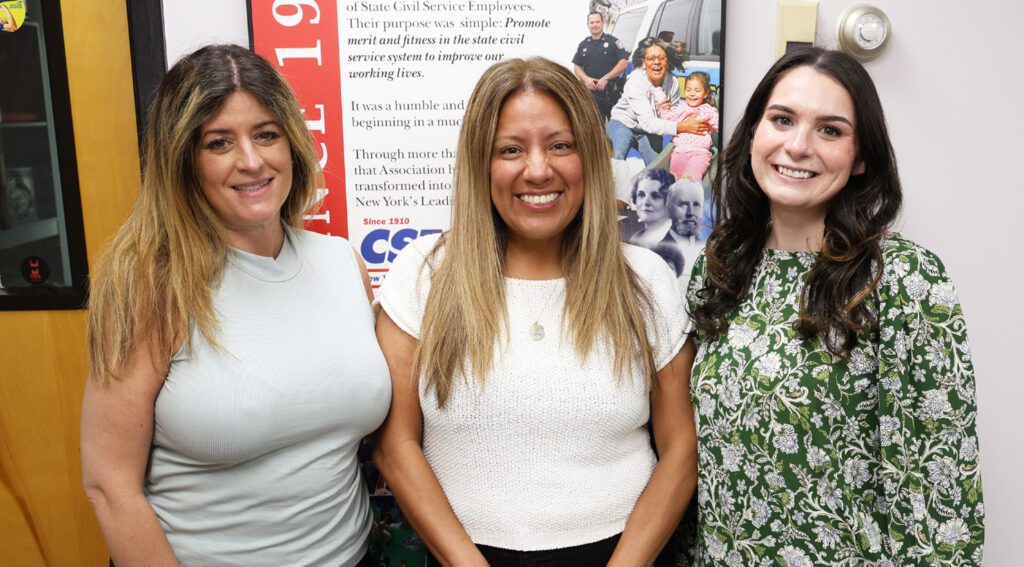
Pelliccia, Jacqueline Lopez and Jillian D’Erasmo were working together during the discovery period of organizing, which made them a natural fit to become CSEA’s Seaford Library organizing committee.
Each of the committee members works in a different area of the library, which helps in getting multiple perspectives, which is helpful when deciding what is best for a group of workers.
Pelliccia, Lopez, and D’Erasmo presented workers with facts to show that forming a union with CSEA would be beneficial. Committee members also suggested that workers visit CSEA’s website to familiarize themselves with the benefits and discounts that our union membership provides. Additionally, they explained CSEA’s network of members and staff who will work with them.
When Pelliccia, Lopez and D’Erasmo felt overwhelmed by their roles, there would always be a sign that their task was necessary.
“There were a few times when something negative would happen at work and we would look at each other and say, ‘You see. We need a union,’” said Lopez. “Those instances validated our reasons for organizing.”
The librarians eventually won voluntary recognition as a union, giving the workers a long-needed voice at work.
The committee credits unionizing the library with making them stronger people.
“It helped to strengthen our resolve; we made a decision and even though we were getting pushback from the library board, we’re sticking to it,” said D’Erasmo.
“We told them that organizing isn’t an attack on them,” said Lopez. “If someone from the library board leaves, the workers will still be there. We don’t know what the new board member will do. Being part of a union gives workers protection.”
Committee members kept the rest of the library workers informed with emails, Zoom meetings, and in-person communication.
The ability to advocate for themselves is the main reason why workers wanted to join CSEA.
“Who is going to look out for your best interest at your job, other than you?” said Pelliccia. “Supposedly, the library board was our advocate for better raises and that’s probably why we weren’t getting anything. You have to put your money where your mouth is. I’m tired of complaining. I want the change and results you get with a union behind you.”
— Wendi Bowie