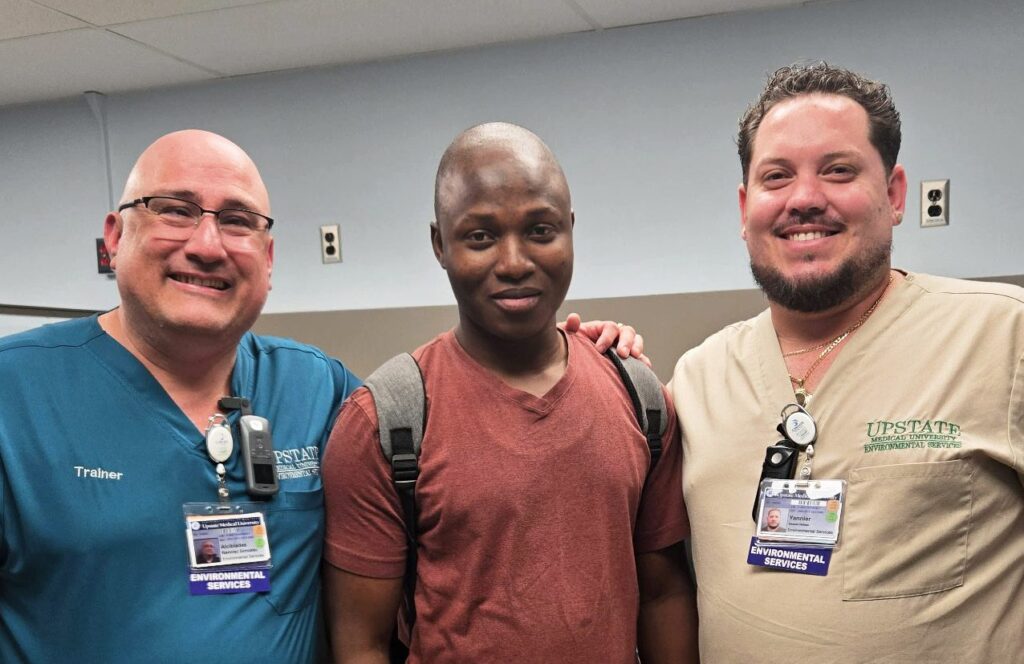
SYRACUSE — As the United States marks its 250th anniversary, SUNY Upstate Medical University employee Mohamed Fofana is back home in Syracuse, back at work, and back in school, focused on building a future he says brought him to America in the first place, even after months in federal immigration detention.
Fofana was released from detention following federal court approval of a habeas corpus petition. He returned home to Syracuse, where he was reunited with his family, friends and co-workers who supported him throughout his time in custody.
While his release allows him to remain at home as his case continues, his immigration matter is still ongoing.
Seeking safety
For Fofana, the return brings both relief and uncertainty, but also a continuation of a journey he says began when he came to the United States seeking safety and opportunity.
Before arriving in the United States, Fofana said he completed nursing school in Guinea. He said he came to the U.S. with the goal of continuing that work and building a safer future.
After arriving, he said he followed required immigration check-ins while pursuing education and employment in the health care field.
“Every appointment, they ask me what I’m doing,” he said. “I’m going to school because I want to be a nurse here.”
Fofana said his path changed suddenly when he was detained during a routine immigration appointment. He was taken into federal custody and transferred between multiple facilities from Batavia to Texas over the course of several months.
He described detention as one of the most difficult experiences of his life. He noted that the ordeal left him fearful of returning to custody, even as he focuses on rebuilding his life.
“I’m scared again to go because I don’t want to go again in detention,” said Fofana. “I want to stay here in America. I don’t want to go back. I’m scared to go back. I want to stay here in America to become a citizen.”
Still pursuing the American dream
Since returning home, Fofana has resumed his education and returned to work at SUNY Upstate Medical University, where he continues building experience in a hospital setting while pursuing his goal of becoming a nurse.
On his first day back at the hospital after returning home, Fofana noted that many of his co-workers visited him, something he said meant a great deal after months of uncertainty.
Among those who came were Alcibiades “Alex” Lazaro Ramirez Gonzalez and CSEA member Yannier “Yan” Vazquez Hidalgo, fellow SUNY Upstate Medical University workers who had also recently been detained by immigration authorities and whose cases drew widespread community and union support.
For Fofana, seeing them in person after his return showed the solidarity among workers at SUNY Upstate and the shared determination to continue showing up for patients despite some of the most difficult personal circumstances imaginable.
Fofana’s story is one of several in Central New York to draw attention from labor organizations and community advocates. Other SUNY Upstate employees have also faced immigration detention and deportation proceedings. CSEA SUNY Upstate Medical University Local President Ali B. Cottrell said Fofana’s release reflects the importance of due process and community support while legal cases continue.
“Mohamed’s release is welcome news for his family, his co-workers and our community,” said Cottrell. “While his legal journey is not yet over, we are grateful that he is home. This outcome reflects the power of advocacy, community support and faith in the legal process.”
As the nation looks ahead to the America 250 celebration, Fofana said his experience has not changed his outlook on the American Dream. He said he views the United States as a place where people can build new beginnings.
“I came to America because it’s a country for freedom,” he said. “They help everyone; they protect people’s lives. I’m here to save my life.”
He added that his goal has remained unchanged since arriving.
“I want to be a nurse,” he said. “I work in the hospital because in my mind, I want to be a nurse because I want to help my community.”
— Nicholas Newcomb