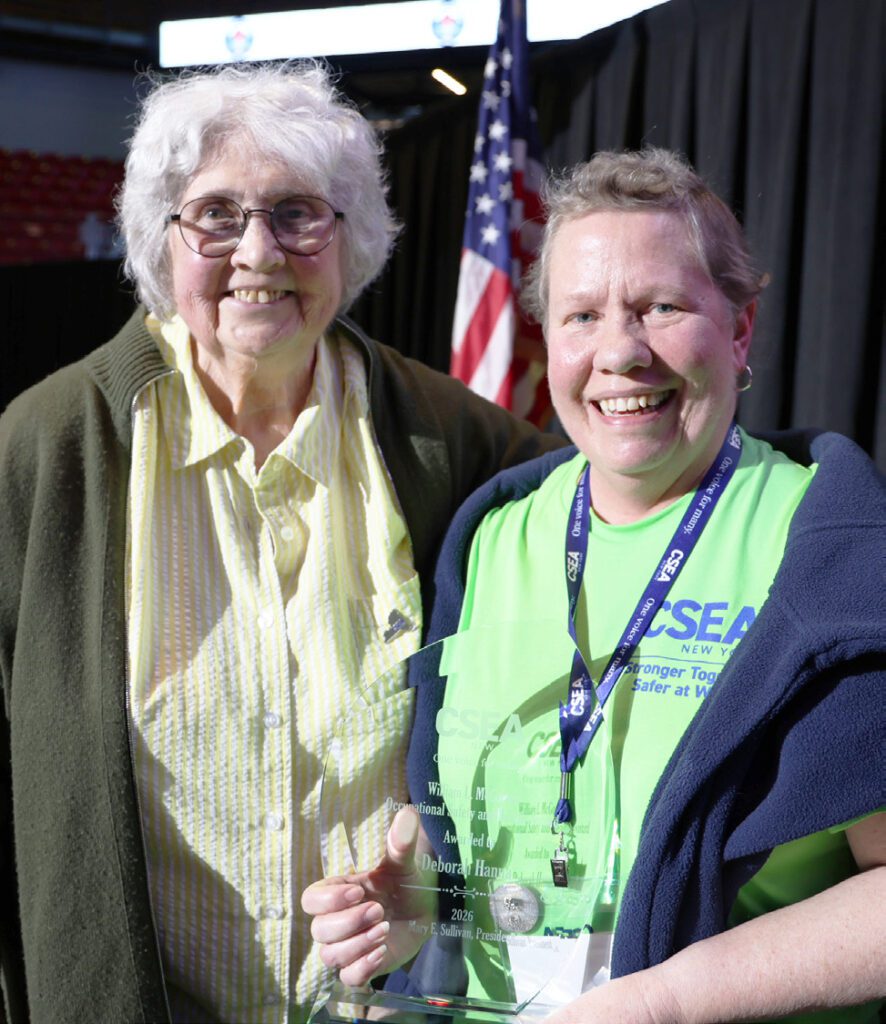
MANHATTAN — For Deborah Hanna, workplace safety isn’t measured only by landmark victories.
Sometimes it’s a better ventilation system, a safer walkway or even moving a misplaced rug before someone gets hurt.
That philosophy has guided Hanna throughout her career as president of CSEA’s Health Research Inc. (HRI) Local, earning her this year’s William L. McGowan Award at our union’s Statewide Conference on Occupational Safety and Health.
“It really is a recognition of all the work that has happened over time,” said Hanna. “You make one small change, and then things start building one on top of the other.”
Among those achievements, none stands taller than the successful campaign to improve working conditions at 90 Church Street in Lower Manhattan during the rebuilding that followed the Sept. 11 terrorist attacks.
When New York state announced plans to relocate employees from 5 Penn Plaza to 90 Church Street as part of the effort to revitalize Lower Manhattan, Hanna and her fellow union leaders supported the move. Their concern wasn’t the relocation itself — it was ensuring workers would be protected in a building located beside what was then the world’s largest construction site.
“We said, ‘We’ll move to Lower Manhattan, but we need it to be safe,’” said Hanna.
Partnership leads to victory
What began as a simple petition signed by workers from several unions quickly evolved into the 90 Church Street Coalition after appeals to state officials went unanswered. The coalition united CSEA members with workers represented by other unions, community organizations and public officials around a common goal: making sure rebuilding Lower Manhattan did not come at the expense of workers’ health.
With support from CSEA’s Occupational Safety and Health Department, industrial hygienists and health and safety specialists helped evaluate conditions and provide technical expertise that strengthened the coalition’s proposals.
Throughout the effort, coalition members organized rallies, testified before committees, spoke at public forums and built relationships with elected officials who eventually became allies in the campaign.
The partnership paid off.
The coalition successfully secured major improvements, including upgraded HVAC systems with HEPA filtration, enhanced water quality monitoring, double-pane windows to reduce dust, debris and construction noise, and health and safety standards that were ultimately extended throughout the building for state, city and federal employees.
The campaign also demonstrated that a workplace issue can have implications far beyond one building or one group of employees. The standards workers fought for helped influence health and safety efforts throughout the surrounding area.
“This was a health and safety issue, but in some ways, it was not just a health and safety,” said Hanna. “This was true community sort of collaboration. We wanted 90 Church Street to be an example of what could be and should be a good, stellar building for health and safety for its workers.”
The campaign also became a model for other buildings throughout Lower Manhattan.
“It took everybody,” said Hanna. “Nobody is on an island.”
The improvements would prove their value repeatedly. Construction returned to the area years later, creating new challenges for workers. And when employees returned after the COVID-19 pandemic, the building’s improved HVAC and filtration systems provided another important layer of protection.
“I cannot imagine having, trying to work a day in this building without some of these improvements,” Hanna said. “It makes a huge difference in the quality of everyone’s healthy workplaces.”
Solidarity key to safety
For Hanna, the experience reinforced an important lesson that continues to guide her union activism today.
“There is huge power in joining forces,” said Hanna. “One person can speak, but when you have dozens of people standing together behind that message, that’s when real change happens.”
Hanna is quick to point out that protecting workers often begins with addressing more commonplace potential hazards.
“Safety and health can be something as simple as a rug that’s badly placed, a file cabinet in the wrong location or an air vent causing problems,” said Hanna. “Those issues may seem small, but they’re just as important to the people they’re affecting.”
That commitment has kept Hanna active on region and statewide health and safety committees, where she continues to advocate for safer workplaces for CSEA members across New York.
She also credits countless CSEA activists and staff who helped make those victories possible, including the late Standing Occupational Safety and Health Committee Chair Frank Consentino and former Metropolitan Region 2 President George Boncoraglio, along with OSH staff, communications professionals and union leaders who contributed their expertise throughout the campaign.
Looking ahead, Hanna hopes future activists remember that meaningful change often begins with one determined voice.
Recalling a favorite saying about the surprising power of a mosquito, Hanna said the lesson is simple: “You may think you’re just one person, but you have a lot more power than you honestly think you have.”
It’s a lesson that has helped improve countless workplaces — and one that continues to inspire CSEA’s ongoing commitment to protecting its members.
— David Galarza