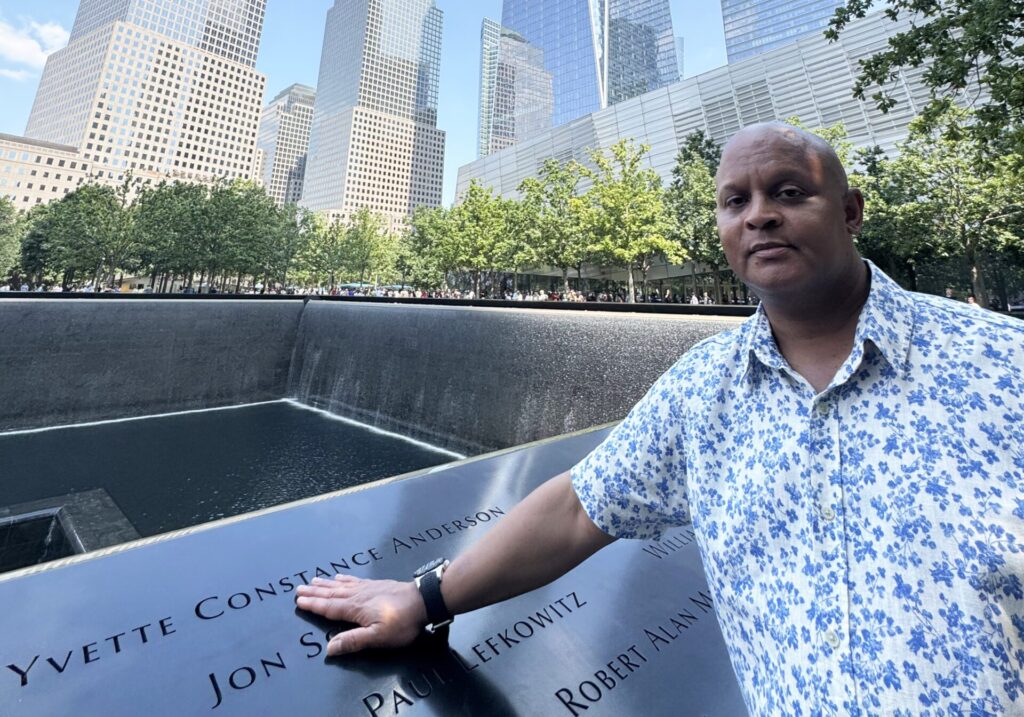
Twenty-five years after the terrorist attacks of Sept. 11, 2001, the memories remain vivid for the CSEA members and public employees who witnessed the devastation firsthand, escaped the World Trade Center and returned to work in Lower Manhattan in the difficult years that followed.
Harrowing escape
For Terrell Silver, a retired New York State Department of Taxation and Finance employee, Sept. 11 began as an ordinary morning at his desk on the 86th floor of the World Trade Center’s South Tower.
Then came the explosion.
Silver turned toward the window and saw smoke, fire and debris coming from the neighboring North Tower. He did not yet know what had happened, but his instincts told him something was terribly wrong.
“Instinctually, I just knew something was wrong,” said Silver. “I wanted to get out the building. I wasn’t going back to my desk.”
He began making his way down the stairs before 9 a.m. The descent would take at least an hour.
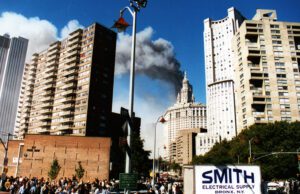
At one point, an intercom announcement directed workers toreturn to their desks. Silver ignored it.
“I remember the announcement that came across telling everybody that, you know, everything was OK, and just go back to your desks or whatever,” he said. “I didn’t listen to that.”
As he made his way down, the staircase suddenly shook.
“The whole staircase shook when I was on the staircase,” said Silver. “Everybody froze ‘cause we didn’t know what the hell that was.”
He would later understand that the shaking occurred when the second plane struck the South Tower.
Silver kept moving.
As he descended, the number of people in the stairwell began to thin. At the time, he didn’t understand why. In retrospect, he realized that his position below the impact zone likely saved his life.
“I had to be below the impact because I wouldn’t be here talking to you,” said Silver.
Relief and grief
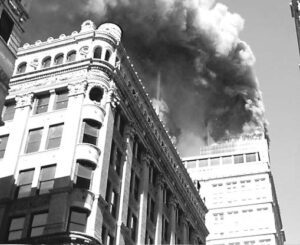
After escaping the building, Silver headed toward Brooklyn, eventually reaching Taxation & Finance’s Brooklyn office. There, his co-workers greeted him with relief.
But the relief of surviving was soon accompanied by the painful realization that many colleagues and friends had not made it out.
Among them was Yvette Anderson, a close friend described by Silver as a woman of faith who was nearing completion of a hospitality degree and dreamed of opening her own restaurant. There were reports that Anderson had stayed behind to help her wheelchair-using boss down the stairs. Neither survived.
Silver also remembers Richard Moore, a colleague in his 60s who, like Silver, successfully escaped the World Trade Center by walking down all 86 floors.
Moore died a week later.
“He made it out like I did, and he ended up dying a week later,” said Silver. “That was like a double hit to the heart.”
The human toll continued to reveal itself in the days and weeks that followed. People Silver had seen in the stairwell — people he assumed had escaped — were among those who had died.
The attacks also left an indelible mark on Silver’s family. His mother, who was working as a home attendant that morning, saw the burning towers on television and feared the worst. When she finally heard her son’s voice, she screamed with relief.
“To hear my mother screaming on the phone, that was…heartbreaking, ’cause she thought she lost her son,” said Silver.
Twenty-five years later, Silver says he has learned to live with the memories. He credits his faith with helping him move forward.
“Traumas like that have a way of showing up in certain ways in your life,” said Silver. “I never sought any kind of psychological help. I didn’t feel like I needed it. I just depended on my faith.”
His perspective is simple but profound.
“If you wake up in your bed every day and you’re still alive and well, that’s a blessing,” said Silver.
Fighting for safety

For Deborah Hanna, president of CSEA Health Research Inc. Local, the legacy of 9/11 is also tied to the rebuilding of Lower Manhattan — and to the responsibility of unions to make sure workers were protected as the neighborhood was transformed.
Before the attacks, Hanna’s local and other state agencies were based in Midtown.
As Lower Manhattan began its massive rebuilding effort, state agencies were asked to relocate to 90 Church Street, a building that had been damaged in the attacks and stood next to the World Trade Center.
CSEA, other unions, elected officials and community members joined together to form the 90 Church Street Coalition that fought successful to ensure strong safety standards.
For Hanna, the most important lesson from the 90 Church Street campaign is the power of collective action.
“I would say it was the power of multiple voices coming forward as one,” said Hanna. “You can’t do anything without helping all of us together.”
She believes that lesson remains as relevant today as it was 25 years ago.
“We really ultimately are the voice of everybody in one person,” said Hanna. “It’s the power of many.”
The World Trade Center site stands both as a memorial to those who were lost and as a living part of the city.
Hanna sees that evolution as important.
“I’m so happy to see where the spirit of the Trade Center site continues as a memorial of those folks who lost their lives,” said Hanna. “But it continues to be a living and evolving place. It’s not just a memorial. It is a vibrant part of New York City and Lower Manhattan.”
For Silver, remembrance is inseparable from gratitude.
“We lost a lot of people, a lot of wonderful, beautiful people,” said Silver. “I wish it didn’t happen, but it did. But just keep on living.”
— David Galarza
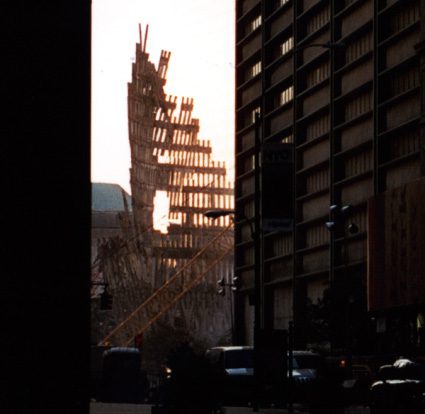
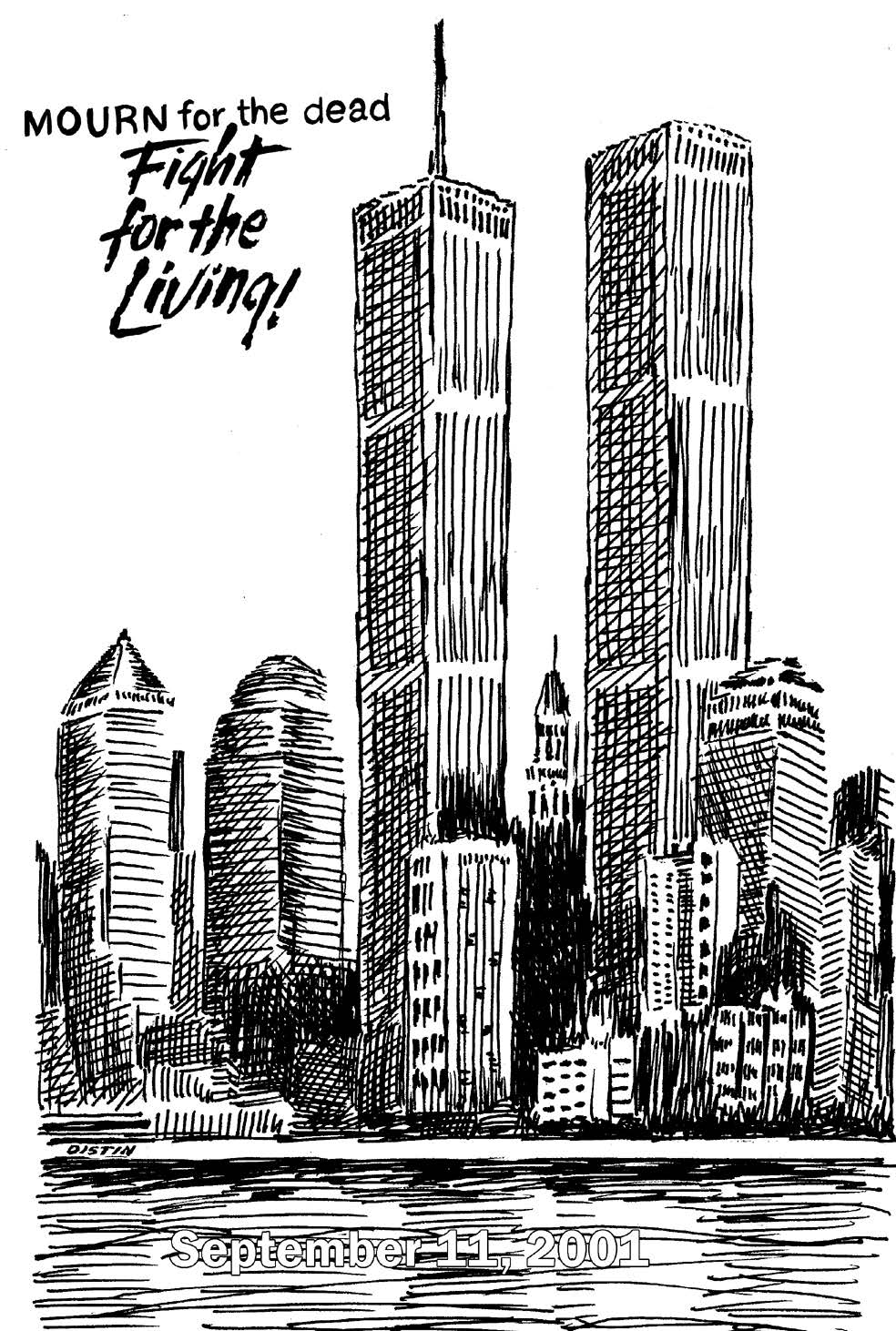
created by former CSEA Graphic Artist Ralph Distin, was
used as a cover for the October 2001 issue of The Work Force, as well as a poster.
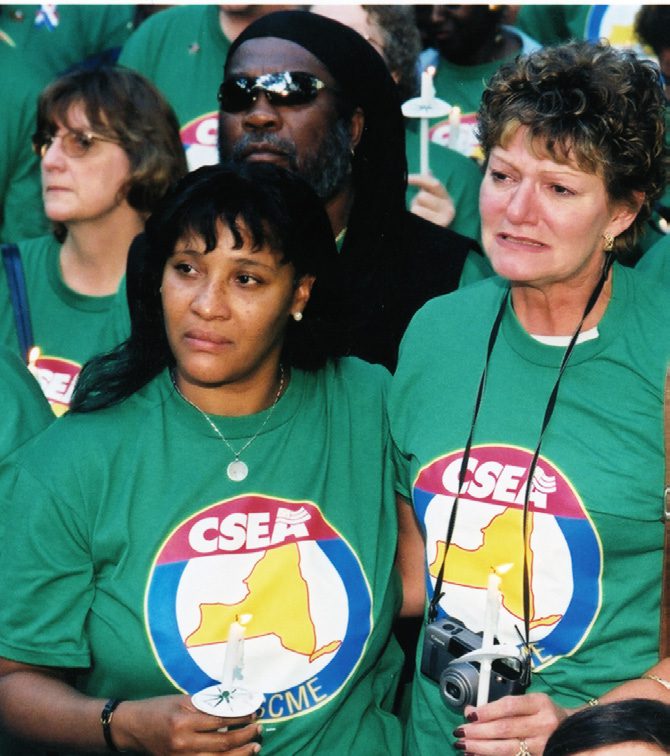
11, 2002, in Central Park to
remember those lost during the
attacks. (Photo by Gary Schoichet.)
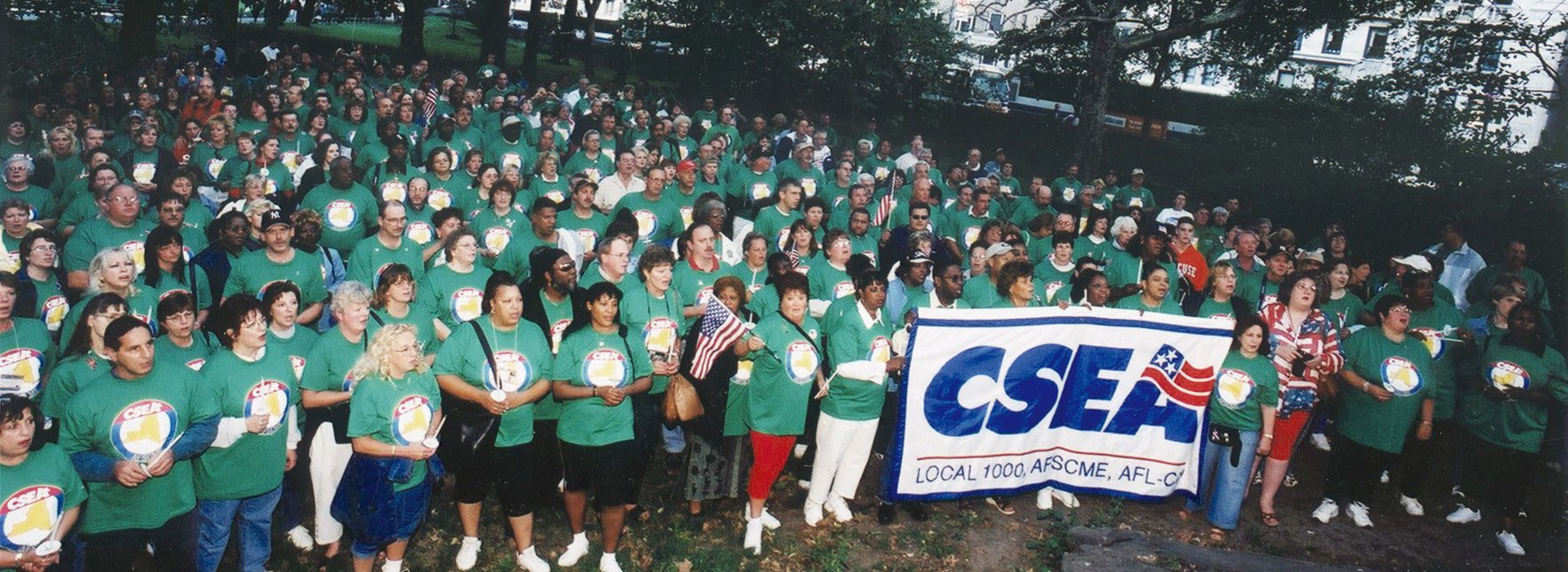
the lives lost in the World Trade Center attacks a year earlier. The vigil coincided with CSEA’s 2002
Annual Delegates Meeting held in New York City. (Photo by Gary Schoichet.)