As we begin a new year, the consequences of recent federal actions continue to unfold, extending a troubling pattern of attacks on worker protections and public institutions.
An executive order targeting state artificial intelligence (AI) safeguards, along with ongoing dismantling of the U.S. Department of Education (DOE), underscores the federal government’s escalating efforts to weaken the rights and services millions of Americans depend on.
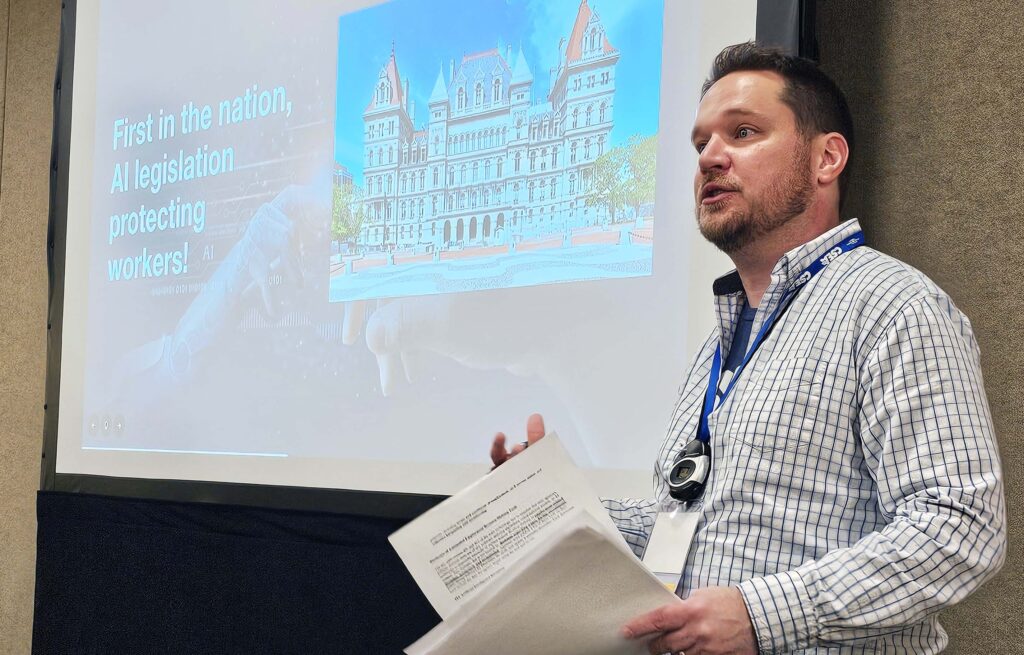
In November, President Donald Trump signed an executive order designed to override state-level AI laws. The order directs the U.S. Attorney General to challenge states that enact their own AI protections and instructs the U.S. Department of Commerce to withhold more than $42 billion in Broadband Equity, Access, and Deployment funds from states that enforce AI regulations.
This action directly targets New York, where Gov. Kathy Hochul has advanced some of the strongest AI safeguards in the nation to protect children, workers and consumers. Last year, she signed legislation preventing the displacement of employees in state agencies and public authorities due to AI, with a related bill still awaiting action to extend similar protections to SUNY, local governments and school districts. These safeguards are now at risk under the new order.
Also in November, the Trump administration announced additional steps in its ongoing effort to dismantle the Department of Education. The proposal would shift key federal education responsibilities, including K–12 support, higher education funding and major grant programs, to the U.S. Department of Labor.
This restructuring aligns with administration’s stated goal of ultimately closing the Education Department. Since January, the department has laid off roughly 2,000 employees, about half of its workforce, further eroding federal support for students, educators and school communities.
These federal actions reflect a broader assault on the protections and public services that workers rely on.
Safeguarding workers and preserving strong public services will remain at the center of our work as we confront these ongoing challenges in 2026.
— Bryan Miller